

In modern manufacturing, producing a high-quality component involves much more than shaping and assembling materials. The final treatment of a product can have a major impact on its appearance, durability, corrosion resistance, and overall performance.
Surface Finishing is therefore an important part of the manufacturing process. Depending on the material and intended application, manufacturers can use different finishing techniques to improve surface quality and create products that meet specific performance requirements.
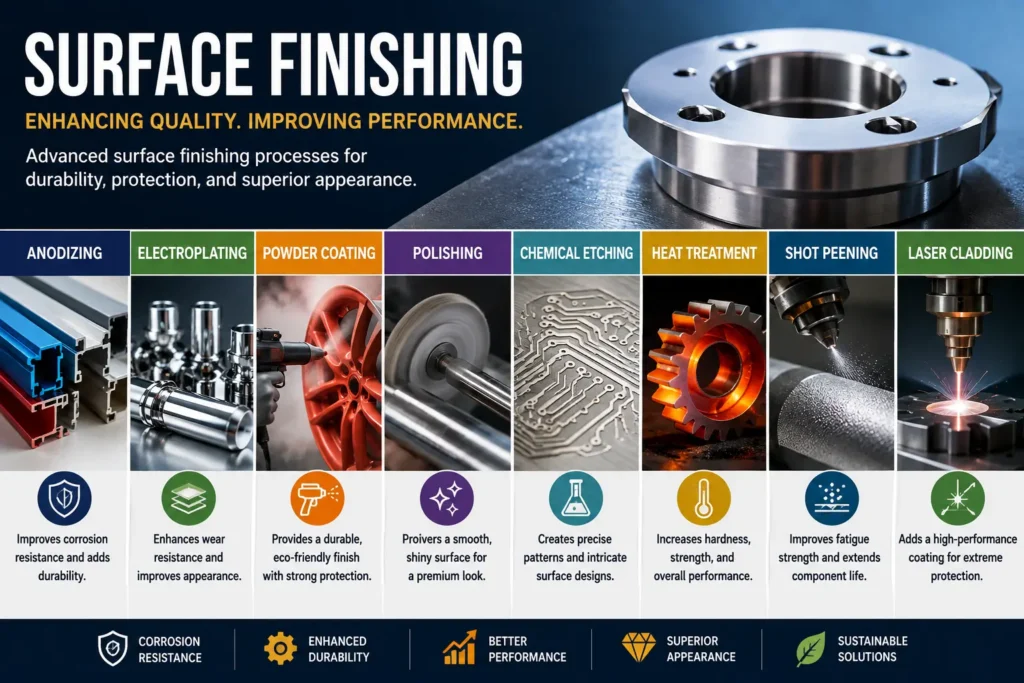
From anodizing and electroplating to powder coating, polishing, chemical etching, and laser cladding, modern Surface Finishing technologies provide manufacturers with a wide range of options.
Why Is Surface Finishing Important?
The right Surface Finishing process can improve both the functional and visual properties of a manufactured component.
A suitable finishing method can help manufacturers achieve:
- Better corrosion resistance
- Improved wear resistance
- Greater surface hardness
- Enhanced appearance
- Improved electrical performance
- Easier cleaning and maintenance
- Longer product lifespan
- Better dimensional and surface consistency
The ideal Surface Finishing method depends on factors such as the material, operating environment, required appearance, production volume, and performance requirements.
1. Anodizing for Improved Durability
Anodizing is an electrochemical process that enhances the natural oxide layer on a metal surface. It is particularly common for aluminium components because it can improve protection against corrosion and everyday wear.
As a Surface Finishing technique, anodizing can also provide manufacturers with a range of decorative options.
Key Benefits of Anodizing
Corrosion Resistance: The anodized layer provides additional protection against environmental exposure.
Improved Durability: Anodized surfaces can offer better resistance to everyday wear.
Aesthetic Options: Different colours and finishes can be created for products where appearance is important.
Because of these advantages, anodizing is widely considered when both protection and appearance are required.
2. Electroplating for Precision and Protection
Electroplating involves depositing a thin layer of metal onto a substrate using an electrical current. The deposited layer can provide specific properties that improve the performance of the finished component.
This Surface Finishing method can be useful in applications where conductivity, corrosion resistance, or wear resistance is important.
Key Benefits of Electroplating
- Improved electrical conductivity
- Increased corrosion resistance
- Better wear protection
- Reduced friction in certain applications
- Enhanced appearance
The choice of plating material depends on the requirements of the final product and its operating environment.
3. Powder Coating for a Durable Finish
Powder coating is a dry coating process in which powdered material is applied to a surface and then cured using heat.
It creates a hard and durable layer that can protect components while also improving their appearance.
As a modern Surface Finishing solution, powder coating is attractive for manufacturers looking for a combination of durability and visual quality.
Advantages of Powder Coating
- Strong resistance to chipping
- Good scratch resistance
- Long-lasting appearance
- Wide range of colours and textures
- Lower VOC emissions than many traditional liquid coating processes
The result is a consistent finish that can be suitable for many industrial and commercial applications.
4. Polishing for a Smooth and Attractive Surface
Polishing is a mechanical process used to smooth a material and create a refined or glossy appearance.
It is commonly used on materials such as metals, plastics, and stone. In some applications, specialised blasting equipment can also be used to achieve a particular surface appearance or texture.
Polishing is an important Surface Finishing option when both appearance and cleanliness matter.
Benefits of Polishing
Improved Appearance: A smooth surface can create a high-quality visual finish.
Easier Cleaning: Smooth surfaces are generally easier to clean and maintain.
Reduced Surface Contamination: In industries such as food processing and healthcare, surface quality can be particularly important for hygiene and maintenance.
5. Chemical Etching for Detailed Components
Chemical etching uses controlled chemical reactions to remove material from a surface and create detailed patterns or designs.
This method can produce intricate shapes that may be difficult or expensive to achieve through conventional machining.
Chemical etching is a valuable Surface Finishing and manufacturing technique for applications that require precision and fine detail.
Advantages of Chemical Etching
- High design flexibility
- Precise patterns
- Ability to create intricate features
- Suitable for several metal types
- Useful for specialised components
Industries such as electronics and aerospace can benefit from processes that allow manufacturers to create detailed components efficiently.
6. Heat Treatment for Increased Hardness
Heat treatment involves carefully controlled heating and cooling cycles to modify the physical and mechanical properties of metals.
Although heat treatment differs from purely cosmetic finishing methods, it can play an important role in improving the performance of a component’s surface and material structure.
Key Benefits
- Increased hardness
- Improved strength
- Better resistance to wear
- Improved dimensional stability in suitable applications
- Customised material properties
Manufacturers can select specific heating and cooling cycles based on the desired properties of the finished component.
7. Shot Peening for Fatigue Resistance
Shot peening involves bombarding a material surface with small particles to introduce compressive stresses.
This can help improve resistance to fatigue and delay the formation or growth of certain surface cracks.
As part of a broader Surface Finishing strategy, shot peening can be particularly valuable for components exposed to repeated loads or demanding operating conditions.
Benefits of Shot Peening
- Improved fatigue resistance
- Better surface durability
- Increased resistance to certain forms of cracking
- More consistent surface characteristics
The process parameters need to be carefully controlled to achieve the required result without damaging the component.
8. Laser Cladding for Advanced Surface Protection
Laser cladding is an advanced process that uses a laser beam to fuse a coating material onto a substrate.
The process can create a strong bond between the coating and the underlying material while allowing manufacturers to control the coating’s thickness and composition.
Laser cladding represents a modern Surface Finishing technology for applications that require enhanced wear or corrosion resistance.
Key Advantages
Precision: Coating thickness and composition can be carefully controlled.
Durability: The resulting layer can improve surface performance in demanding environments.
Reduced Material Waste: Precise application can reduce unnecessary coating material compared with some conventional methods.
How to Choose the Right Surface Finishing Process
There is no single Surface Finishing method that works for every manufacturing application.
Before selecting a process, manufacturers should consider:
- Material type – Different metals and materials respond differently to finishing techniques.
- Required durability – Consider the level of wear, corrosion, or environmental exposure.
- Appearance – Determine whether the component requires a polished, coloured, textured, or functional finish.
- Operating environment – Temperature, moisture, chemicals, and mechanical stress can influence the choice.
- Production requirements – Manufacturing volume and processing time should also be considered.
- Cost – The finishing method should provide the required performance while remaining commercially practical.
A careful evaluation can help manufacturers select a Surface Finishing process that matches both technical and business requirements.
The Future of Surface Finishing
Manufacturing continues to move toward greater precision, automation, sustainability, and resource efficiency.
New Surface Finishing technologies are increasingly focused on reducing material waste, improving process control, extending product life, and achieving consistent results.
Laser-based processes, advanced coatings, automated inspection, and digitally controlled production systems are helping manufacturers improve quality while reducing unnecessary processing.
Sustainability is also becoming increasingly important. Manufacturers are looking for finishing methods that reduce emissions, minimise waste, and use resources more efficiently.
Final Thoughts
Modern Surface Finishing processes can significantly influence the quality, durability, appearance, and performance of manufactured products.
Techniques such as anodizing, electroplating, powder coating, polishing, chemical etching, heat treatment, shot peening, and laser cladding each provide different advantages.
The best Surface Finishing approach depends on the material, application, environmental conditions, required performance, appearance, and production requirements.
By carefully selecting the appropriate process, manufacturers can produce more durable and reliable components while improving product quality and maintaining a competitive advantage.
Ultimately, investing in the right Surface Finishing technology is not simply about making a product look better. It is about improving how that product performs, lasts, and meets the expectations of customers and modern manufacturing standards.