


Financial crime continues to evolve, posing significant risks to businesses of all sizes. From money laundering and terrorist financing to fraud and sanctions violations, organizations face increasing regulatory scrutiny and substantial financial penalties for non-compliance. According to global estimates, money laundering accounts for approximately 2% to 5% of global GDP, making it one of the largest financial crimes worldwide.
As regulations become stricter and criminal methods more sophisticated, businesses can no longer rely on manual compliance processes. A modern Anti-Money Laundering (AML) case management system enables organizations to detect suspicious activities, investigate high-risk cases, maintain complete audit trails, and meet regulatory obligations efficiently.
Why AML Case Management Is Important
Money laundering is no longer limited to banks and financial institutions. Criminals now exploit businesses across industries, including fintech, real estate, insurance, legal services, cryptocurrency, gaming, e-commerce, and luxury goods. Any organization that processes customer payments or financial transactions can become a target.
An effective AML case management system helps organizations:
- Detect suspicious transactions in real time.
- Investigate alerts through structured workflows.
- Reduce compliance risks and regulatory penalties.
- Maintain complete documentation for audits.
- Improve collaboration between compliance teams.
- Meet global AML and KYC regulatory requirements.
Key Features of Modern AML Case Management
Today’s AML solutions combine artificial intelligence, machine learning, and automation to strengthen compliance programs. Modern platforms provide:
- AI-powered transaction monitoring.
- Risk-based customer profiling.
- Automated alert prioritization.
- Centralized case management.
- Integrated KYC and Customer Due Diligence (CDD).
- Suspicious Activity Report (SAR) management.
- Complete audit logs and regulatory reporting.
6 Best Practices for AML Case Management
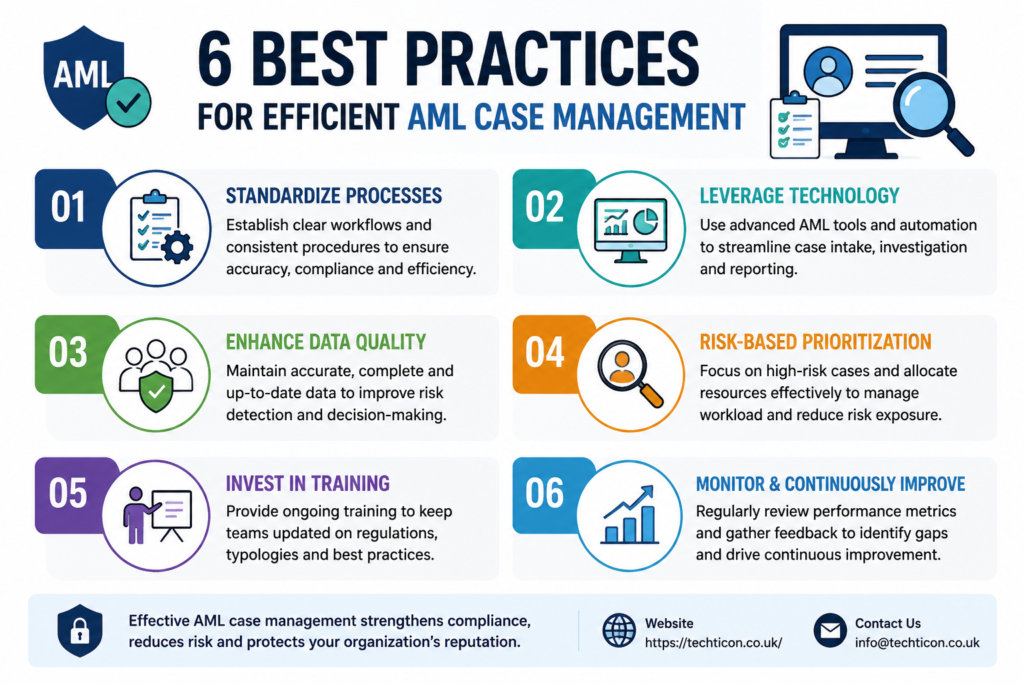
1. Transaction Screening
Monitor customer transactions continuously against sanctions lists, watchlists, politically exposed persons (PEPs), and high-risk jurisdictions. Early detection helps prevent suspicious transactions from going unnoticed.
2. Risk Assessment
Once an alert is generated, investigators should evaluate customer behavior, transaction history, source of funds, and business relationships to determine the level of risk.
3. Investigation Planning
Assign investigators based on case complexity and priority. Define clear objectives, timelines, and compliance requirements before beginning the investigation.
4. Case Investigation
Gather evidence, review supporting documents, communicate with relevant departments, and document every action. High-risk cases should be escalated immediately according to internal AML policies.
5. Follow-Up and Reporting
Monitor the effectiveness of corrective actions and file regulatory reports whenever required. Maintain detailed records to support future audits and compliance reviews.
6. Continuous Review and Improvement
Regularly evaluate investigation outcomes, identify compliance gaps, update AML policies, and provide ongoing staff training to strengthen the compliance program.
Benefits of AML Case Management Software
Implementing AML software provides several advantages:
- Faster investigations through workflow automation.
- Reduced false positives using AI and machine learning.
- Improved regulatory compliance.
- Centralized documentation and audit trails.
- Better collaboration among compliance teams.
- Lower operational costs.
- Enhanced detection of money laundering and terrorist financing.
Instead of relying on spreadsheets or manual investigations, businesses can automate repetitive compliance tasks, allowing analysts to focus on high-risk cases and complex investigations.
Final Thoughts
AML compliance is no longer optional—it is an essential component of modern risk management. Organizations that implement an advanced AML case management system can improve operational efficiency, strengthen regulatory compliance, and better protect themselves against financial crime. As regulatory expectations continue to evolve, businesses should invest in intelligent AML solutions that combine automation, AI-driven analytics, and robust investigation workflows to stay ahead of emerging threats.