


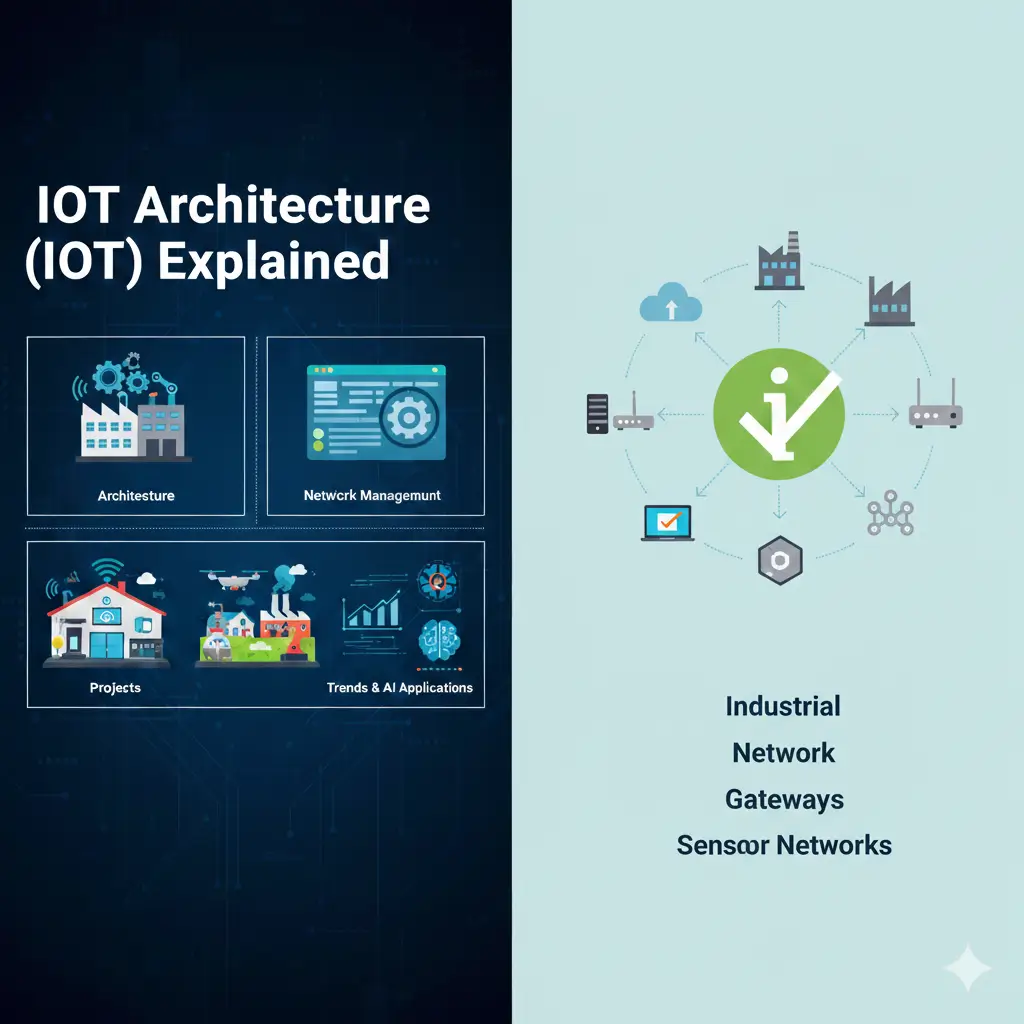
IoT is remaking businesses, cities, and industries everywhere in the world, and that includes UK. Smart manufacturing, smart transportation networks, smart buildings, smart energy management-all are now a reality due to the emergence of the Internet of Things.
IoT architecture stands at the center of all IoT solutions. Without a robust and well-designed architecture laying the foundation for IoT solutions, these solutions will differ in terms of speed, security, and cost-effectiveness. Knowing what iIoT architecture entails, understanding industrial IoT architecture, IoT network architecture, and wireless sensor network IoT is vital.
In this detailed guide, we will clearly explain:
l What IoT architecture is
l How IoT works in industrial and enterprise environments
l The role of sensors, gateways, and networks
l What reference architecture in IoT means
l How IoT architecture is used in real-world UK industries
Simple English has been used in this piece, and even a beginner will be able to understand most of the words.
What Is IoT Architecture?
Architecture, in its place, refers to the structured design that defines the functioning of the Internet of Things devices, Internet of Things networks, Internet of Things platforms, and Internet of Things applications as a whole.
In simple words, IoT architecture defines:
l How data is collected
l How data is transmitted
l How data is processed
l How decisions or actions are taken
All IoT frameworks are composed of layers. Each layer has been designed for performing a particular type of function. Layering facilitates the development of scalable, secure, and robust IoT systems by different organizations.
IoT Architecture Layers Explained
Most of the current applications of IoT are based on multi-layer architectures. Different paradigms can be present, but the fundamental idea is basically the same.
1. Device Layer (Sensor Layer)
This is the foundation of any IoT system.
l Collecting real-world data
l Converting physical signals into digital data
Examples of IoT devices include:
l Smart meters
l Industrial sensors
l Wearable health devices
l Environmental monitoring sensors
In an IoT concept regarding the wireless sensor network, small sensors will cooperate to get large areas covered in factories, farmlands, or smart cities.
2. Gateway Layer (Internet of Things Gateways)
These gateways “connect the IoT to the cloud or data centre, and IoT devices are usually connected to a gateway.” It means IoT devices are connected with the gateway.
Their key roles include:
l Collecting data from sensors
l Filtering and preprocessing data
l Translating communication protocols
l Providing security and authentication
In industrial environments, gateways are critical because they:
l Reduce latency
l Improve reliability
l Allow local decision-making
For example, in a UK manufacturing plant, gateways can stop a machine instantly if a fault is detected, without waiting for cloud instructions.
3. Network Layer (IoT Network Architecture)
Common communication technologies include:
l Ethernet
l Wi-Fi
l Bluetooth
l LoRaWAN
l NB-IoT
l 4G and 5G
In industrial IoT architecture, networks must be:
l Highly reliable
l Low latency
l Secure
l Able to handle large data volumes
The UK is rapidly embracing the 5G IoT network adoption for smart transportation, logistics, or smart infrastructure applications.
4. Data Processing Layer
This layer handles:
l Data storage
l Data analytics
l Real-time processing
Data may be processed:
l On the edge (near the device)
l In the cloud
l In hybrid environmentsEdge computing is becoming popular in iIoT architecture because it reduces delays and improves operational efficiency.
5. Application Layer
The top layer is where users interact with IoT systems.
This includes:
l Dashboards
l Mobile apps
l Web platforms
l Alerts and reports
For example:
l Factory managers monitoring machine health
l City councils tracking traffic congestion
l Energy companies managing smart grids
What Is Reference Architecture in IoT?
The question often comes up: “Is it legal?”, and this is true, in particular, for companies involved in large-scale IoT projects.
Reference architecture, in this context, is the standard architecture that offers guidelines and recommendations to implement IoT architecture.
It helps organisations:
l Avoid design mistakes
l Ensure interoperability
l Improve security
l Speed up development
A reference architecture does not impose the solution but rather acts as a pointer or guide to which modifications can be done at will to suit business needs.
Importance of Reference Architecture in IoT
Using a reference architecture in IoT is important because:
l It reduces development time
l It supports scalability
l It ensures compliance with standards
l It improves system reliability
In the UK, many enterprises follow reference architectures aligned with:
l ISO standards
l Industrial best practices
l Cloud provider frameworks
Industrial IoT Architecture Explained
The architecture of the Industrial IoT is to connect the machines, equipment, and systems.
Typical industries using the architecture of iIoT are:
l Manufacturing
l Energy
l Oil and gas
l Transportation
l Utilities
Key Features of Industrial IoT Architecture
l Real-time data processing
l High availability
l Strong cybersecurity
l Long device lifecycles
In contrast to consumer IoT devices, Industrial Automation requires components operating non-stop 24/7.
Wireless Sensor Network IoT
Benefits of Wireless Sensor Networks
l Easy deployment
l Low power consumption
l Scalable design
l Cost-effective monitoring
Wireless sensor networks are widely used in:
l Smart agriculture
l Environmental monitoring
l Industrial safety systems
l Smart buildings
In the UK, these systems are commonly deployed for air quality monitoring and flood detection.
Role of IoT Gateways in Modern Architecture
Internet of Things gateways are one of the most critical components of IoT architecture.
They help by:
l Managing device connections
l Improving data security
l Enabling edge analytics
l Reducing bandwidth usage
IoT in Architecture and Smart Buildings
IoT in architecture refers to using connected devices in building design and management.
Smart buildings use IoT for:
l Energy management
l Smart lighting
l Climate control
l Security systems
In the UK, IoT-based smart buildings help organisations meet:
l Sustainability targets
l Energy efficiency regulations
l Carbon reduction goals
IoT A Architecture vs Traditional IT Architecture
IoT a architecture is different from traditional IT systems.
Key differences include:
l Millions of devices instead of users
l Real-time data instead of static data
l High scalability requirements
l Strong security at device level
This makes IoT architecture more complex but also more powerful.
Security in IoT Architecture
Fair to say, security is the biggest concern when it comes to
“Some of the key security measures that include:
l Device authentication
l Data encryption
l Secure gateways
l Network segmentation
UK organizations must adhere to various requirements of data protection legislation, including the GDPR.
Challenges in IoT Network Architecture
Some common challenges include:
l Device compatibility
l Network reliability
l Power management
l Data privacy
An effective IoT network architecture combats these issues smoothly.
Future Trends in IoT Architecture
Key trends include:
l AI-powered analytics
l Edge computing
l Digital twins
l 5G-enabled IoT
Why IoT Architecture Matters for Businesses
For UK businesses, investing in the right IoT architecture means:
l Better operational efficiency
l Lower costs
l Improved decision-making
l Competitive advantage
Conclusion
Knowledge of IoT architecture, industrial IoT architecture, IoT network architecture, and Wireless Sensor Network IoT is required for a digital transformation expert. In the context of IoT, a reference architecture will help the enterprise to develop robust, elastic, and future-proof IoT systems. It is clear that while IoT adoption escalates in the UK, those investing in proper architecture lead into the future smart economy.
Frequently Asked Questions (FAQs)
What is IoT architecture?
“Internet of Things architecture” is defined as the design or structure that illustrates how the devices, networks, platforms, and applications interact with each other in the Internet of Things ecosystem.
What is industrial IoT architecture?
The architecture of Industrial Internet of things consists of machine and system interconnections within a manufacturing environment, such as a factory or a power plant.
What is a wireless sensor network IoT?
It refers to a technology that has a set of wireless sensors that are responsible for data collection and transmission to monitor or study a given environment or system.
How is IoT used in architecture?
Applications of IoT in the architectural field include smart buildings, particularly in the aspects of energy efficiency, security, and automation.