


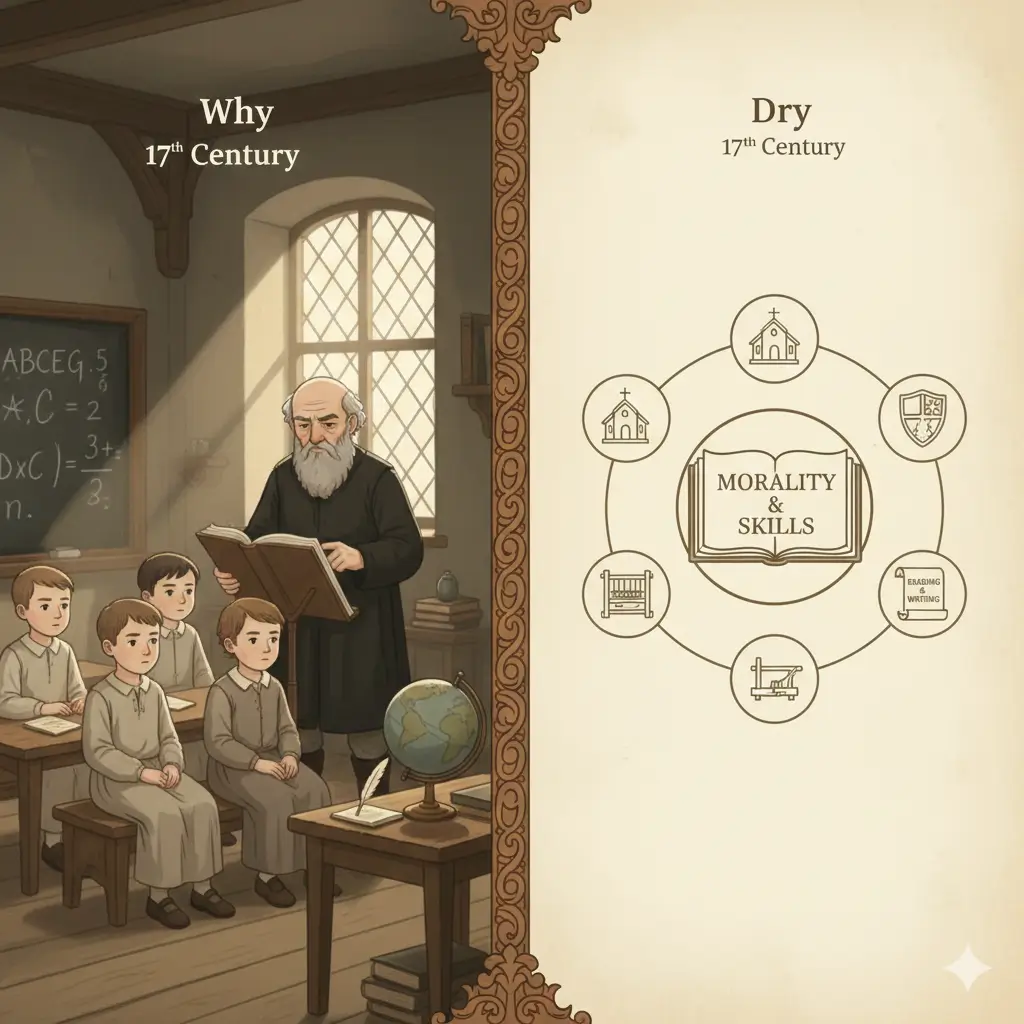
Education has always been a prominent part of human society, but the reasons for which children were educated in the past are completely different from the present. The 17th century was a period of immense transformation in England and the British Isles, and the mindset regarding education was affected by religion, society, economy, and politics. It is essential to understand why children were educated in the 17th century to understand how the young minds were shaped long before the advent of modern education.
In this article, we will give a brief and fascinating history of education. We will concentrate on England and the UK scenario, explaining how and why education for children came into existence and what were the reasons behind teaching children by adults.
Introduction: A New Age of Change
There were changes in religion, government and daily life. This was the age of:
l The English Civil War
l The rise of Parliament
l Growing towns and trade
l New religious movements
l The beginnings of scientific thinking
With all of these changes occurring, the attitude that adults had towards children and education began to shift.
Religious Motives: Reading the Bible and Moral Training
One of the most important reasons children were educated in the 17th century was religion.
1 The Rise of Protestant Beliefs
However, by the early 1600s, England was comprised mostly of Protestants. The Protestants felt that everyone should be able to read the Bible. If people could read, they could read God’s word for themselves. This was a new idea in world history.
People thought that if children could read the Bible:
l They would choose the right path in life.
l They would behave morally and avoid sin.
l They would grow into responsible members of the Christian community.
Many families and leaders in communities believed in education, particularly reading and writing, so that children could read religious texts.
2 Sunday Schools and Religious Instruction
Churches provided basic learning on Sundays, sometimes referred to as early Sunday Schools.
Here, the focus was not on maths or science but on:
l Reading the Bible
l Learning prayers
l Understanding religious morals
The belief was that moral character was as important as reading ability.
Social and Civic Reasons: Preparing for Society
Children were educated not just for religion but also for society.
1 Obedience and Social Order
The society in the 17th century was an organized society. Children believed that they required education to teach them their place in society. Education taught children rules and expectations.
Adults taught children to be:
l Obedient to parents and authority
l Disciplined in behaviour
l Respectful in society
2 The Role of Families and Communities
In different fields of England, especially in rural England, parents supported educating children. Schools were a very rare occurrence, and parents and the community taught children basic skills in their homes.
Economic Reasons: Skills for Work and Trade
Another key reason for educating children was the economy — the world of work.
1 Growing Towns and New Jobs
As towns expanded, families understood that children needed some basic skills such as:
l Reading
l Writing
l Arithmetic (simple maths)
2 Learning Through Apprenticeships
For many children, especially boys, formal education did not exist. They learned through apprenticeships – that is:
l Living with a master craftsman
l Learning a trade or skill
l Practising the work every day
An apprentice learned:
l Carpentry
l Blacksmithing
l Tailoring
l Printing
l Other skilled trades
Gender and Social Class: Who Got an Education?
Not every child in the 17th century received the same education. Social class and gender were important factors.
1 Education for Boys
Boys, especially from wealthier families, had more schooling opportunities:
l Grammar schools
l Private tutors
l University education (for the richest)
l Many families wanted their sons to continue in:
l Government roles
l Church positions
l Trade or business
So education was seen as a route to a better future for boys.
2 Education for Girls
Girls’ education was much more limited in the 17th century.
Most girls learned:
l Reading (mainly for religious reasons)
l Sewing and household skills
l Behaviour expected of women
Very few girls from ordinary families went to formal schools. Only women from wealthy families could sometimes have private lessons.
So gender influenced why children were educated — boys received more academic instruction, while girls often learned practical home skills.
3 Class Differences
Children from rich families had more access to education. They might:
l Attend grammar schools
l Have tutors
l Go to university
Children from poor families often learned at home or in local parish schools, where resources were limited.
This meant that education was uneven, and social class played a big role in what children learned.
Schools in the 17th Century: What Were They Like?
Education in the 17th century looked very different from today.
1 Grammar Schools
Grammar schools were the main formal schools. They focused on:
l Latin language
l Religious instruction
l Some basic maths
Grammar schools prepared boys for university or church work.
These schools were mostly in towns and offered better learning opportunities than rural village teaching.
2 Charity and Parish Schools
Parish schools were basic community schools organised by the church.
They taught:
l Reading
l Writing
l Christian morals
They were often supported by donations from wealthier people.
Charity schools aimed to give poor children basic skills so they could work and support themselves.
3 Home Education
Many children were educated at home, especially in villages.
Parents taught simple skills themselves:
l Reading psalms or prayer books
l Counting
l Craft or farm skills
Home education was important because formal schools were rare outside towns.
New Ideas and Influences on Education
During the 17th century, new ideas about learning began to spread.
1 The Influence of New Scientific Thinking
The 17th century was the age of early modern science. Thinkers like Isaac Newton and Francis Bacon changed how people thought about knowledge.
Learning became connected with:
l Observation and reasoning
l Asking questions
l Understanding the world
These ideas influenced teachers and educated adults, even if most children did not study science formally.
2 The Role of Printing
Books became more available because of printing. The Bible, prayer books, and simple reading books reached more households.
This support for reading helped spread literacy among children. Even if they learned at home, children could read words from books that were easier to find.
What Subjects Did Children Learn?
Education in the 17th century was limited compared to today, but children did learn valuable skills.
1 Reading
Reading was the main subject for most children. It helped them:
l Read the Bible
l Understand religious lessons
l Gain basic literacy
Books used for learning were simple and often religious.
2 Writing
Writing was taught mostly to boys and only where schooling was available.
Children learned to:
l Write letters
l Copy religious texts
l Keep simple records
3 Maths
Simple maths was part of learning when possible. Arithmetic was useful for:
l Counting money
l Measuring
l Work skills
Maths was basic — far from modern standards — but practical.
Challenges in Education
Education in the 17th century faced many challenges.
1 Lack of Formal Schools
Not every town or village had a school. In rural areas, children often learned at home or in informal church groups.
2 Poverty
Poor families often needed children to work, so education was not always a priority. Many children helped with farm work or household duties instead of studying.
3 Limited Resources
Books and trained teachers were rare outside major towns. Many teachers knew little beyond basic reading and religion.
How Education Changed Society
Despite limitations, education helped transform society.
1 More People Could Read
This wider literacy helped:
l Spread news and ideas
l Strengthen religious awareness
l Increase communication
2 Education and the Economy
Children with basic education helped towns grow. Workers with reading and maths skills could:
l Manage trade
l Keep records
l Join new forms of labour
3 Foundations for Future Reform
The ideas and efforts of the 17th century set the stage for later educational reform. Over the next centuries, education slowly became:
l More structured
l More available to ordinary children
l Less focused only on religion
Conclusion: Why Were Children Educated in the 17th Century?
Children were educated in the 17th century for different reasons, but the following are the dominant themes:
Social Order
Education promoted obedience, discipline, and qualities necessary for good citizenship.
Economy
Basic skills prepared children for trade, apprentices, and the growth of towns.
Families and Communities
Parents, the church, and the community worked together in educating children.
New Ideas
The development of new concepts of literacy, science, and the book helped to promote education.
Frequently Asked Questions (FAQs)
1. Why was reading more important than writing?
Reading was needed to understand the Bible. Writing was useful but not necessary for religious learning.
2. Did boys and girls receive the same education?
No. Boys received more education. Girls usually learned reading for religion and skills for home life.
3. Were poor children educated?
Some poor children learned basic reading in church or at home, but many had to work and missed education.
4. How did printing help education?
Printing made books cheaper and more available. More families could own Bibles and reading materials.
5. Was science part of children’s education?
Not directly. However, new scientific ideas slowly changed how adults thought about learning and knowledge.