



Introduction
In today’s digital world, software development has become one of the most important fields of technology. Every mobile application, website, desktop application, cloud platform, banking system, healthcare management system, and e-commerce platform is built through a structured software development process. From small businesses to multinational companies, organizations rely on software solutions to improve productivity, automate tasks, manage data, and provide better services to customers.
Software development is not just about writing code. It is a complete process that starts with understanding business requirements and ends with maintaining and improving the software after it is released. A successful software product requires proper planning, communication, technical knowledge, testing, and continuous updates.
The Software Development Life Cycle (SDLC) provides a systematic approach to building software. It divides the entire project into different phases so developers can complete projects efficiently while maintaining quality, security, and performance.
This guide explains every major phase of software development, including planning, requirements gathering, system design, development, testing, deployment, and maintenance. It also discusses the benefits, challenges, best practices, and future of software development.
What Is Software Development?
Software development is the process of designing, creating, testing, deploying, and maintaining software applications. It involves analyzing user requirements, designing system architecture, writing source code, testing software quality, releasing applications, and continuously improving them based on user feedback.
Software developers use programming languages such as Python, Java, C++, JavaScript, PHP, and C# to build software for computers, smartphones, websites, cloud services, and embedded systems.
The primary objective of software development is to produce software that is reliable, secure, scalable, user-friendly, and capable of solving real-world problems.

Why Is Software Development Important?
Modern businesses depend heavily on software development to remain competitive. Whether managing customer information, processing online payments, automating business operations, or delivering digital services, software plays a critical role in every industry.
Some important reasons why software development is essential include:
- Improves business efficiency.
- Automates repetitive tasks.
- Enhances customer experience.
- Increases productivity.
- Reduces operational costs.
- Improves data security.
- Supports business growth.
- Enables digital transformation.
- Creates innovative products and services.
- Helps organizations make better business decisions.
Without software development, technologies such as social media, online banking, artificial intelligence, cloud computing, and e-commerce would not exist.
Software Development Life Cycle (SDLC)
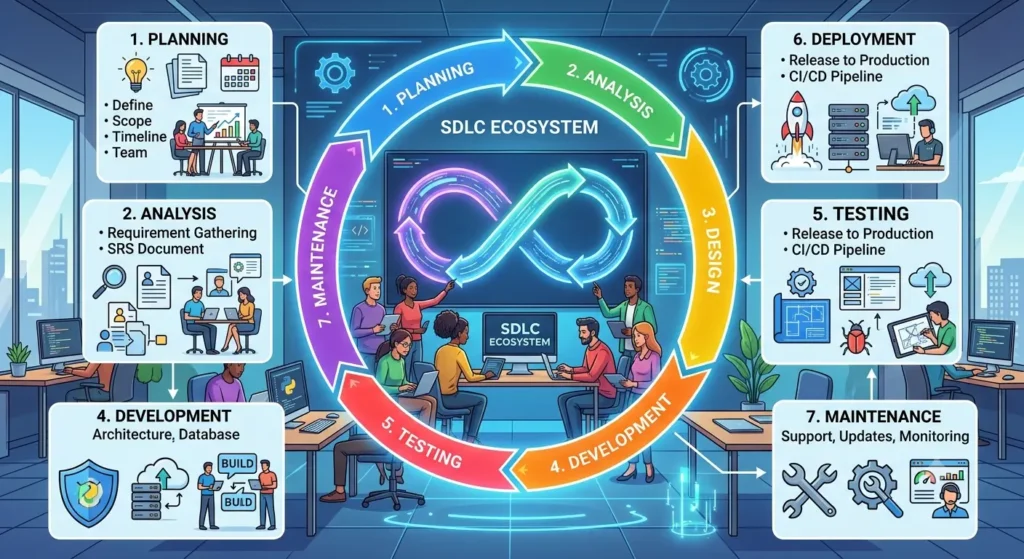
The Software Development Life Cycle (SDLC) is a structured process used to develop high-quality software efficiently. It divides software creation into several phases, allowing teams to manage projects more effectively.
The major phases include:
- Planning
- Requirements Gathering
- System Design
- Development
- Testing
- Deployment
- Maintenance
Each phase has a specific purpose and contributes to the success of the software project.
Phase 1: Planning
Planning is the foundation of every successful software development project. During this stage, the development team identifies project goals, business objectives, timelines, resources, budgets, and possible risks before development begins.
Proper planning ensures that every team member understands the project’s scope and responsibilities. It also reduces unexpected problems during development.
Objectives of Planning
- Define project goals.
- Understand business requirements.
- Estimate project cost.
- Estimate development time.
- Identify project risks.
- Select development technologies.
- Assign team responsibilities.
- Create a project roadmap.
Importance of Planning
Planning provides a clear direction for the entire project. It improves communication between stakeholders and developers while reducing project delays and unnecessary expenses.
Organizations that invest enough time in planning usually complete projects faster with higher quality.
Benefits of Planning
- Better project management
- Reduced development cost
- Lower project risks
- Improved communication
- Better resource utilization
- Faster software delivery
- Higher software quality
Phase 2: Requirements Gathering
Requirements gathering is one of the most critical phases of software development. During this stage, developers collect information from clients, stakeholders, and end users to understand exactly what the software should accomplish.
Business analysts organize meetings, interviews, surveys, and discussions to collect detailed project requirements.
Requirements are usually divided into two categories.
Functional Requirements
Functional requirements explain what the software should do.
Examples include:
- User registration
- Login system
- Search functionality
- Online payment
- Report generation
- Email notifications
Non-Functional Requirements
Non-functional requirements describe how the software should perform.
Example include
- Security
- Performance
- Reliability
- Scalability
- Availability
- Usability
- Data privacy
Activities During Requirements Gathering
- Interview stakeholders
- Conduct business meetings
- Gather customer feedback
- Analyze business processes
- Prepare Software Requirement Specification (SRS)
- Review requirements
- Obtain client approval
Benefits of Requirements Gathering
- Prevents misunderstandings
- Reduces development errors
- Saves project cost
- Improves customer satisfaction
- Makes development easier
- Reduces project risks
A clear understanding of project requirements significantly increases the chances of successful software development.
Phase 3: System Design

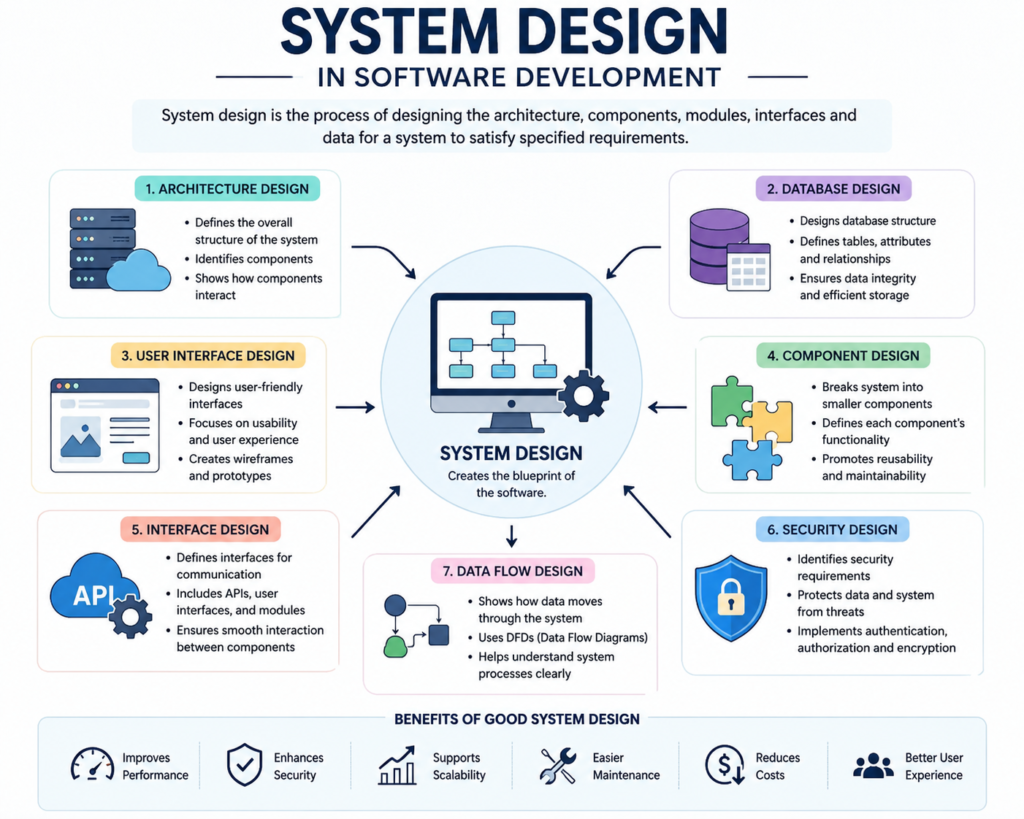
After the requirements have been gathered and approved, the next phase of software development is System Design. This phase creates the blueprint for the entire software project. Instead of writing code immediately, developers first decide how the software will be structured, how different modules will communicate, how data will be stored, and how users will interact with the system.
A well-designed system improves performance, security, scalability, and maintainability. It also reduces coding errors and makes future updates easier.
Types of System Design
High-Level Design (HLD)
High-Level Design focuses on the overall architecture of the software. It explains how different modules interact with each other and how data flows through the application.
High-Level Design includes:
- Software architecture
- System modules
- Database selection
- Server architecture
- Security planning
- Communication between components
Low-Level Design (LLD)
Low-Level Design provides detailed information about every module before coding begins.
It includes:
- Class diagrams
- Database tables
- API structures
- Algorithms
- User interface layouts
- Data validation rules
Benefits of System Design
- Reduces software bugs
- Improves software performance
- Makes coding easier
- Enhances software security
- Supports future expansion
- Improves maintainability
- Provides a better user experience
A strong system design is one of the biggest factors behind successful software development.
Phase 4: Development
The Development phase is where the actual software is built. Developers convert the approved system design into a working application by writing source code using programming languages and development frameworks.
This phase often requires teamwork because different developers work on different modules simultaneously. Modern software development also uses version control systems such as Git to manage source code and collaboration.
Activities During Development
During development, developers perform several important tasks:
- Writing clean source code
- Creating application modules
- Developing front-end interfaces
- Developing back-end logic
- Connecting databases
- Creating APIs
- Fixing coding errors
- Integrating different software components
- Reviewing source code
- Updating project documentation
Best Practices During Development
Professional developers follow several best practices:
- Write readable code.
- Follow coding standards.
- Use meaningful variable names.
- Comment important sections.
- Reuse existing code when possible.
- Test individual modules regularly.
- Maintain proper documentation.
- Use Git for version control.
Benefits of Development
The development phase transforms ideas into real software products. It allows businesses to automate tasks, improve efficiency, and provide digital services to customers.
Without proper development practices, software quality decreases and maintenance becomes difficult.
Phase 5: Testing
Testing is one of the most important stages of software development because it ensures that the software works correctly before it reaches users. Even a small bug can affect user experience, security, or system performance. Therefore, testing helps identify and fix problems before deployment.
The main goal of testing is to verify that the software meets all requirements and performs reliably under different conditions.
Types of Testing
Unit Testing
Each small part of the software is tested individually to ensure it functions correctly.
Integration Testing
Different software modules are tested together to verify that they communicate properly.
System Testing
The complete software application is tested as a whole to ensure every feature works as expected.
User Acceptance Testing (UAT)
Real users or clients test the software to confirm that it satisfies business requirements.
Performance Testing
Performance testing checks whether the software can handle heavy traffic and maintain speed under different workloads.
Security Testing
Security testing identifies vulnerabilities and protects the application from cyber threats such as unauthorized access, malware, and data breaches.
Benefits of Testing
- Detects software bugs early
- Improves software quality
- Enhances security
- Increases customer satisfaction
- Reduces maintenance costs
- Improves software reliability
- Ensures stable performance
Testing is a continuous activity in modern software development, especially in Agile and DevOps environments where software is updated frequently.
Phase 6: Deployment

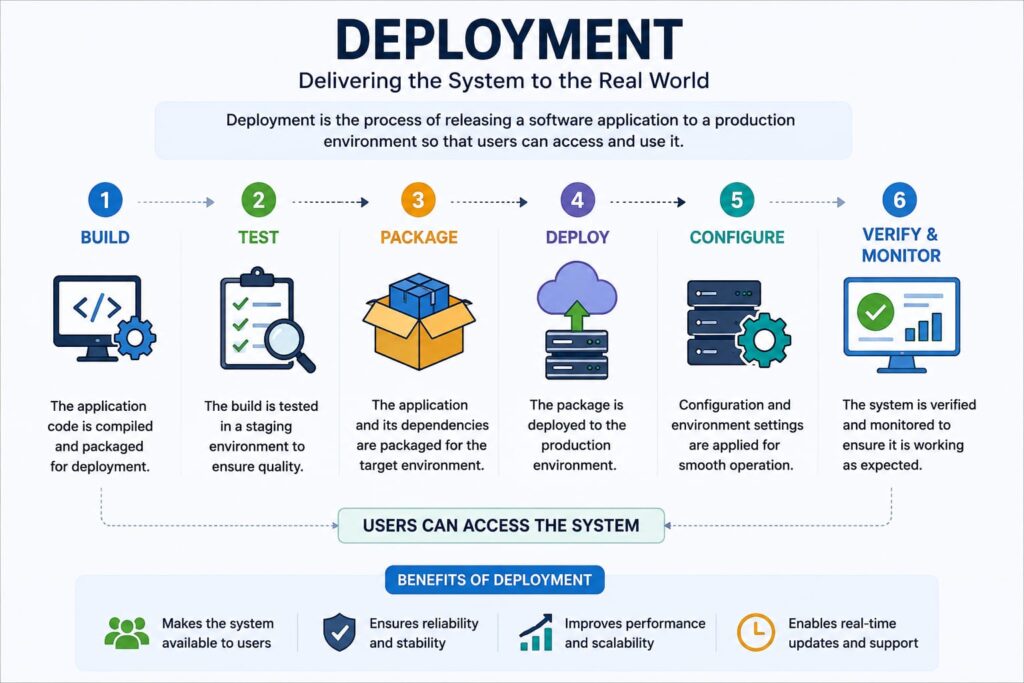
Deployment is the sixth phase of the Software Development Life Cycle (SDLC). In this phase, the software is released to the end users after it has been successfully developed and tested. The main purpose of deployment is to make the application available in a real-world environment where users can use its features and services.
During deployment, the software is installed on a server, computer, or cloud platform. Developers configure the application, databases, and network settings to ensure everything works correctly. The software is often deployed first in a staging environment for final verification before being released to all users. After deployment, developers monitor the application, fix any issues, and provide updates to improve performance, security, and functionality.
Activities in the Deployment Phase
- Installing the software on servers or cloud platforms.
- Configuring databases, servers, and application settings.
- Migrating data from the old system to the new system (if required).
- Performing final testing in the production environment.
- Releasing the software to end users.
- Monitoring system performance and fixing deployment issues.
- Providing updates, patches, and ongoing maintenance.
Benefits of the Deployment Phase
- Makes the software available for real users.
- Ensures the application runs smoothly in the production environment.
- Improves user satisfaction by delivering a working system.
- Helps identify and resolve real-world issues quickly.
- Supports regular updates and security improvements.
- Increases software reliability, performance, and availability.
Phase 7: Maintenance
Maintenance is the seventh and final phase of the Software Development Life Cycle (SDLC). In this phase, the software is regularly monitored, updated, and improved after it has been deployed and is being used by end users. The main purpose of maintenance is to ensure that the software continues to work efficiently, securely, and reliably over time.
During the maintenance phase, developers fix bugs and errors reported by users, improve system performance, and update the software to meet changing business or user requirements. Security patches are applied to protect the system from new threats, and new features may be added to enhance functionality. Regular maintenance helps keep the software compatible with new hardware, operating systems, and technologies.
Activities in the Maintenance Phase
- Fixing bugs and errors reported by users.
- Updating the software with new features and improvements.
- Applying security patches to protect the system.
- Monitoring system performance and reliability.
- Improving software efficiency and usability.
- Ensuring compatibility with new hardware and software.
- Providing technical support and resolving user issues.
Benefits of the Maintenance Phase
- Keeps the software reliable and stable.
- Improves system performance and efficiency.
- Enhances security by fixing vulnerabilities.
- Increases user satisfaction through continuous improvements.
- Extends the lifespan of the software.
- Ensures compatibility with new technologies and platforms.
- Reduces the risk of system failures and downtime.
Conclusion:
Software development is a structured process that transforms ideas into functional and reliable software solutions. From planning and requirements gathering to system design, development, testing, deployment, and maintenance, each phase plays a crucial role in ensuring the success of a software project. Following these phases helps developers build secure, efficient, and high-quality applications that meet user and business requirements. As technology continues to evolve, understanding the software development process remains essential for students, developers, and organizations aiming to create innovative and successful software solutions.